
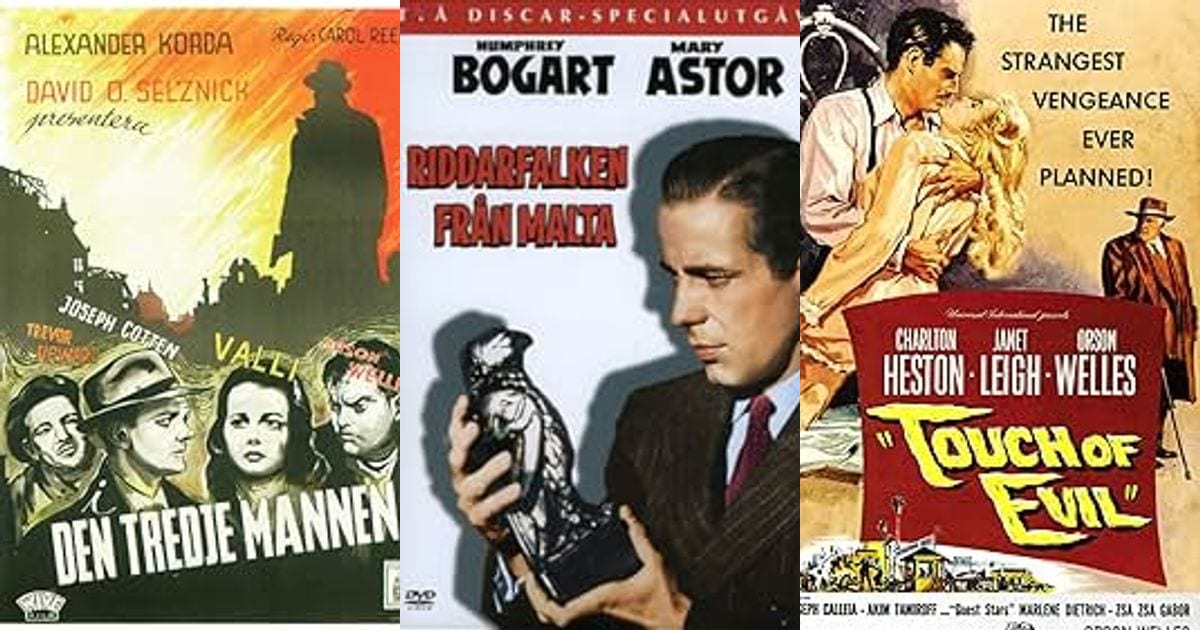
Where the Streets Are Slick With Rain and Sin
It's 3 a.m. A saxophone plays somewhere down the block. A private detective nurses a bourbon, waiting for trouble to walk through his door wearing legs and a dangerous smile. Welcome to film noir.
Flourishing in post-WWII America, noir wasn't just a genre — it was a mood, reflecting a nation's new cynicism. It swapped Hollywood's happy endings for moral ambiguity and inevitable doom.
Where Noir Came From
Noir didn't spring out of nowhere. Its visual DNA traces back to German Expressionism — the jagged shadows and distorted angles of silent films like The Cabinet of Dr. Caligari and Fritz Lang's M. When Hitler rose to power in the 1930s, a wave of German and Austrian filmmakers fled to Hollywood, bringing that shadow-drenched sensibility with them. Fritz Lang, Billy Wilder, Robert Siodmak, and Otto Preminger were all émigrés who helped build the genre from the ground up, and it shows: noir looks the way it does partly because the people making it had already lived through actual darkness.
The other half of noir's bloodline is literary. Hardboiled crime writers like Dashiell Hammett, Raymond Chandler, and James M. Cain were publishing lean, cynical detective fiction in pulp magazines such as Black Mask throughout the 1920s and 30s, and Hollywood adapted their novels wholesale. The Maltese Falcon came from Hammett. Double Indemnity and Mildred Pierce came from Cain. Chandler's Philip Marlowe novels became a small cottage industry of adaptations. These writers gave noir its voice — clipped, wisecracking, world-weary — long before a camera ever slid a shadow across Humphrey Bogart's face.
Then there's the history that made audiences ready to receive all this gloom. Soldiers came home from World War II changed, sometimes disillusioned, sometimes struggling with what we'd now call PTSD, and Hollywood noticed. Meanwhile, the Hays Code was busy policing what filmmakers could show on screen — no glorified crime, no unpunished immorality — which forced writers and directors to get sly. You couldn't show an affair, so you implied it in a lingering glance over a drink. You couldn't let the killers win outright, so you let them almost win, and let the walls close in slowly instead. Noir is, in a strange way, a genre built out of loopholes.
The Noir Starter Pack
- The look: High-contrast black and white, venetian-blind shadows slicing across faces, rain-soaked streets reflecting neon. Visually stunning, every time.
- The protagonist: A hardboiled detective, an insurance man, or an average joe pulled into a crime. Cynical, weary, usually doomed.
- The femme fatale: Gorgeous, seductive, dangerous — she drives the plot and leads the hero straight to his own destruction. He probably knows it, and goes along anyway.
- The voiceover: A weary narrator talking us through his own downfall, often in flashback, because the ending has already happened and everyone in the theater knows it.
- The score: Moody strings, a distant trumpet or sax, music that sounds like it's already grieving the characters before they've done anything wrong.
The Voice in the Dark
One of noir's sneakiest storytelling tricks is structural: it loves to tell you the ending first. Double Indemnity opens with Walter Neff bleeding and confessing into a dictaphone. Sunset Boulevard opens with its narrator floating face-down in a swimming pool, then rewinds to explain how he got there. That's not a spoiler; that's the whole point. Noir isn't interested in whether the protagonist survives — it's interested in watching the trap close, beat by beat, even though you already know how the story ends. It's the cinematic equivalent of watching a car crash in slow motion and being unable to look away, mostly because the film wants you to notice every single decision that led there.
Lighting the Shadows: The Cinematographers Behind the Mood
Noir's iconic look didn't happen by accident — it was engineered by cinematographers working with tight budgets and even tighter shooting schedules who turned limitations into style. John Alton, often called the poet of noir lighting, used single hard key lights and deep shadow to make cheap sets look expensive and dangerous; his work on films like T-Men and Raw Deal is practically a lighting textbook. Nicholas Musuraca, who shot Out of the Past, specialized in shadows that seemed to have their own gravity. Low-key lighting wasn't just cheaper than lighting a full soundstage — it was thematically perfect, since noir is fundamentally about what's hidden, half-seen, or deliberately kept out of frame.
The Femme Fatale, Reconsidered
It's tempting to reduce the femme fatale to "pretty woman who causes problems," but the archetype is more interesting than that shorthand suggests. Barbara Stanwyck's Phyllis Dietrichson in Double Indemnity isn't just seductive — she's the smartest person in the movie, running a con that the supposedly savvy insurance man can't see coming until it's far too late. Jane Greer's Kathie Moffat in Out of the Past reinvents herself so many times that even the audience loses track of which version is real. These women thrive in a genre obsessed with deception because they're often the only characters honest about wanting power in a world that won't hand it to them by any legitimate means. Read one way, the femme fatale is a warning about dangerous women; read another way, she's the most competent person in a film full of men who think they're in control and very much are not.
The Anti-Hero at the Wheel
Noir's protagonists are a rogues' gallery of ordinary men who make one bad decision and then spend ninety minutes watching it compound. Fred MacMurray's Walter Neff in Double Indemnity is a competent, unremarkable insurance salesman right up until he isn't. Edward G. Robinson, an actor best known for playing gangsters, spent several noir pictures playing the exact opposite: a mild, easily manipulated everyman undone by desire in films like Scarlet Street and The Woman in the Window. Robert Mitchum built an entire screen persona out of looking too tired to outrun his own past, which made him perfect for Out of the Past and a string of other noir leads. What unites nearly all of them is that they're rarely the smartest person in the film — the femme fatale usually holds that title — and their downfall comes not from a villain's scheme so much as from their own willingness to believe, just this once, that they can get away with something. Noir doesn't punish evil so much as it punishes hope.
Why Black and White Mattered
By the 1940s, color film existed and Hollywood was already using it for musicals and prestige pictures, which makes noir's commitment to black and white a deliberate choice rather than a technical limitation. Shadow simply reads as more shadow in monochrome — a shaft of light through venetian blinds becomes a cage of bars across a face, and a wet street at night turns into a mirror for streetlamps and headlights in a way that color often flattens. Black and white also let cinematographers get away with cheaper, smaller sets, since deep shadow could hide the edges of a soundstage that a full-color frame would expose. There's a reason the genre's stubborn insistence on shooting in color decades later — as in Chinatown or Body Heat — still gets filed under "neo-noir" rather than plain noir: the black-and-white palette isn't just an aesthetic, it's practically part of the genre's legal definition.
Three Essential Watches
- Double Indemnity (1944): An insurance salesman and a housewife plot to kill her husband. This is the template every noir since has copied.
- The Maltese Falcon (1941): Bogart as Sam Spade in a tangled plot about a statue that's really about greed and betrayal.
- Chinatown (1974): A "neo-noir" in color that captures the genre's spirit while layering in 1970s corruption the 1940s never could show.
More Noir Worth Your Watchlist
Once those three have hooked you, the genre's back catalog goes deep. Out of the Past (1947) is arguably the most purely noir noir ever made — Robert Mitchum trying to outrun a past that keeps finding him anyway. Sunset Boulevard (1950) turns its lens on Hollywood itself, with Gloria Swanson as a faded silent-film star whose grip on reality has slipped just as far as her grip on her own fading stardom. Touch of Evil (1958), directed by and starring Orson Welles as a corrupt border-town cop, closes out the classic era with one of cinema's most famous unbroken opening shots. Kiss Me Deadly (1955) is noir at its most paranoid and nihilistic, ending on an image so bleak it reportedly unsettled its own studio. And Laura (1944) flips the femme fatale formula by making its central woman a portrait and a mystery before she ever appears in the flesh.
Noir Never Left — It Just Changed Coats
Once you spot the pattern, you'll see noir's DNA everywhere — in modern neo-noirs like Blade Runner and Nightcrawler, and in every detective show that opens on rain-slicked streets. Neo-noir has been reinventing the formula for decades: Chinatown proved you could shoot noir in color and lose none of its rot; Body Heat (1981) turned the heat of a Florida summer into its own kind of moral decay; L.A. Confidential (1997) went back to the 1950s setting while using modern filmmaking to expose corruption the original cycle could only hint at; and the Coen brothers' Blood Simple (1984) took noir's fatalism and pushed it into pitch-black comedy. Even Blade Runner's rain-soaked, neon-lit dystopia is essentially a private-eye story wearing a trench coat borrowed straight from Sam Spade, just set decades and one flying car later.
The mood never really left; it just found new decades to haunt. Every time a filmmaker wants to tell you that the world is rigged, that nobody's hands are clean, and that the truth is going to cost somebody everything — they reach for noir's toolkit, whether or not they call it by name. That's the real trick of the genre: it looks like it's about crime, but it's actually about the quiet, permanent suspicion that the game was never fair to begin with.
Movie Genres Explained: A Beginner's Guide to the Basics
Genres are just promises between filmmaker and audience. Here's how to speak the language.
How to Host a Movie Quiz Night (With a Free 40-Question Quiz)
The format, the timing, the scoring, and the four mistakes that sink most home quizzes — plus a complete 40-question movie quiz with answers, ready to run tonight.
Movie Drinking Games That Will Absolutely Get You Too Drunk
A tongue-in-cheek guide to drinking games built around the most repetitive movies and genres of all time, with a serious note on keeping the whole thing fun and safe.