
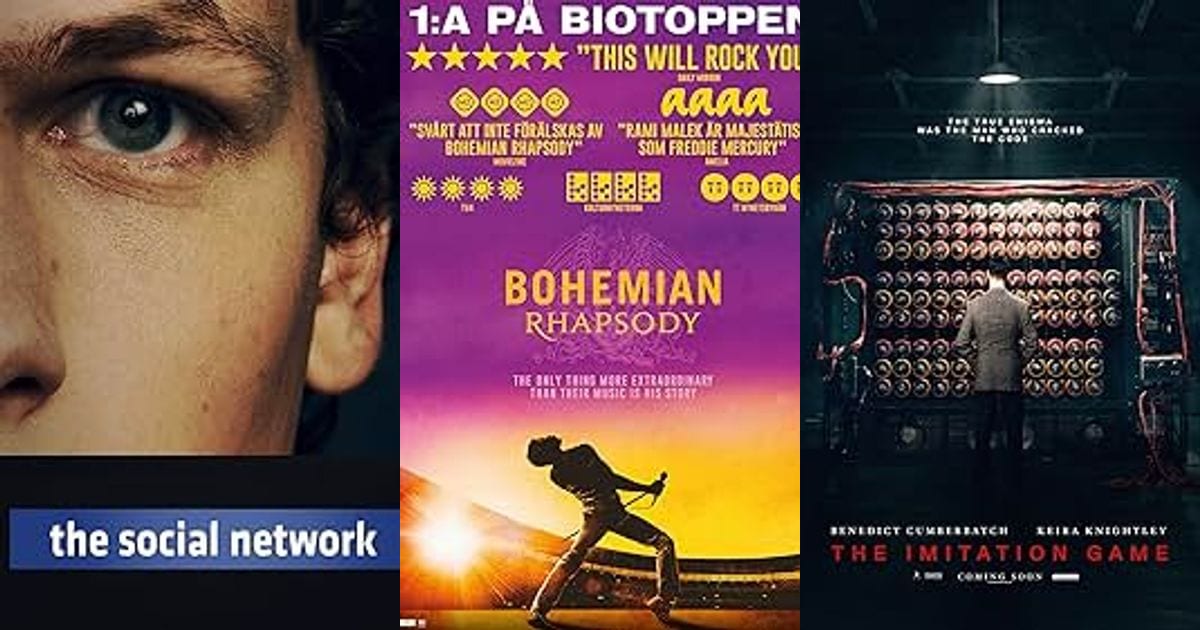
Real Lives, Reel Inspiration
Truth is often stranger — and more inspiring — than fiction. A great biopic doesn't recite a Wikipedia page; it captures the grit required to achieve something monumental. "Oscar bait" is a tired label, but done right, these films send you out of the theater ready to tackle your own mountains. The trouble is that "based on a true story" has become such a reliable marketing hook that studios slap it on everything from prestige dramas to forgettable Lifetime movies, which makes it easy to forget how genuinely difficult a good biopic is to pull off. Compress a whole life, or even one pivotal decade of it, into two hours and you're going to leave things out. Cast a famous face as a real person and you're asking the audience to forget who they're watching. Lean too hard into hagiography and the film turns into a highlight reel; lean too hard into cynicism and you lose the reason anyone wanted to make the movie in the first place.
What Separates a Great Biopic From Oscar Bait
The films on this list all solve that problem the same basic way: they pick a specific, dramatically coherent slice of a life rather than trying to cram in everything, and they trust that slice to say something true about the whole person. They also tend to resist the urge to explain their subject with a single childhood trauma or a tidy therapeutic arc, the way lesser biopics love to do. Real ambition, real talent, and real flaws rarely resolve into a clean three-act structure, and the best films here know it. They also tend to lean on extraordinary lead performances built on real preparation — voice coaches, weight changes, months of practicing an instrument or a sport until it looks like second nature — because audiences can tell the difference between an actor doing an impression and an actor who's actually done the work.
- Schindler's List (1993): Spielberg's harrowing look at humanity's darkest depths and the flicker of hope one person can provide. Adapted from Thomas Keneally's novel Schindler's Ark, the film was shot largely in Poland, near Auschwitz, in stark black and white — a choice that strips away any Hollywood gloss and makes the horror feel documentary-real. Liam Neeson's Oskar Schindler evolves from an opportunistic war profiteer into the reluctant savior of over a thousand Jewish workers, while Ralph Fiennes plays camp commandant Amon Göth with a chilling, almost bureaucratic cruelty. Spielberg reportedly took no directing fee, considering it "blood money," and donated his share of the profits to Holocaust education. The film swept the Oscars, winning seven including Best Picture and Best Director, and John Williams' score — built around Itzhak Perlman's violin — remains one of the most quietly devastating pieces of film music ever recorded.
- Malcolm X (1992): Denzel Washington's career-best performance charts the civil rights leader's full evolution, not just a snapshot. Spike Lee's film draws from The Autobiography of Malcolm X, co-written with Alex Haley, and refuses to flatten its subject into a single, comfortable image. It follows Malcolm Little from a troubled youth and prison stint through his conversion to the Nation of Islam, his rise as one of the era's most electrifying speakers, his public break with Elijah Muhammad, his pilgrimage to Mecca, and his assassination in 1965. Washington earned an Oscar nomination for the role — losing that year to Al Pacino — but the performance has only grown in stature since, largely because it never asks you to like Malcolm X so much as understand the forces, and the intelligence, that shaped him.
- The Social Network (2010): Sorkin's razor dialogue captures the ruthlessness of ambition at the dawn of the digital age. David Fincher directs Aaron Sorkin's screenplay, loosely based on Ben Mezrich's book about Facebook's founding, with Jesse Eisenberg as a chilly, brilliant, socially graceless Mark Zuckerberg and Andrew Garfield as his betrayed co-founder Eduardo Saverin. The dueling depositions structure — cutting between the Harvard dorm room where the idea was born and the lawsuits that followed its success — turns a story about website code into a genuine tragedy about friendship curdling under money and credit disputes. Trent Reznor and Atticus Ross's score, all cold electronic pulses, won the Oscar for Best Original Score, and Sorkin took home Best Adapted Screenplay for dialogue so quotable it's still recited a decade and a half later.
- Goodfellas (1990): The rise and fall of Henry Hill — seductive and terrifying in equal measure. Scorsese adapted Nicholas Pileggi's book Wiseguy, based on the real Henry Hill's account of life inside the Lucchese crime family and his eventual turn as an FBI informant. Ray Liotta's narration seduces you into the glamour of the lifestyle before Scorsese methodically shows you the cost of it — the paranoia, the violence, the friends who become liabilities. Joe Pesci won Best Supporting Actor for a performance built partly on real, terrifying people he'd encountered growing up, and the unbroken Copacabana tracking shot, following Henry and his date through the club's kitchen and past the maître d', remains one of the most imitated pieces of camerawork in American film.
- Hidden Figures (2016): The untold story of the Black women mathematicians vital to NASA's space race. Based on Margot Lee Shetterly's nonfiction book, the film follows Katherine Johnson, Dorothy Vaughan, and Mary Jackson — played by Taraji P. Henson, Octavia Spencer, and Janelle Monáe — as they navigate segregated bathrooms and separate coffee pots while doing calculations essential to John Glenn's orbital spaceflight. What makes the film work is its refusal to treat the women's competence as a surprise; it's presented as simply true, and the drama comes entirely from an institution slow to recognize what was obvious all along. Katherine Johnson lived to see the film and its impact firsthand, a rare case of a biopic's subject watching her own story reach a mass audience.
- Amadeus (1984): A brilliant study of jealousy and mediocrity versus divine genius, through Mozart's rival Salieri. Milos Forman's adaptation of Peter Shaffer's play won eight Oscars, including Best Picture, and hinges on F. Murray Abraham's Oscar-winning performance as an aging Antonio Salieri, confessing decades later to a priest that he may have engineered Mozart's ruin out of envy. It's worth noting this is dramatic license rather than history — there's no real evidence Salieri sabotaged Mozart, and the rivalry is largely legend. But that's almost the point: Amadeus isn't really a Mozart biography so much as a meditation on what it feels like to recognize genius in someone else and know you'll never possess it yourself, dressed in gorgeous 18th-century costume and scored, naturally, by Mozart's own music.
- Raging Bull (1980): Scorsese and De Niro's brutal portrait of boxer Jake LaMotta — difficult, but undeniably powerful. Based on LaMotta's own memoir, the film refuses to make its subject sympathetic in any conventional way; he's jealous, violent, and self-destructive both in and out of the ring, and the film never softens that to earn your affection. Robert De Niro famously trained with LaMotta himself to learn to box convincingly, then gained roughly sixty pounds to play the washed-up, older version of the character, a physical transformation that's become legendary in its own right. Shot in black and white by Michael Chapman, with fight sequences edited into something closer to expressionist violence than sports realism, it's less a boxing movie than a horror movie about a man who can't stop hitting the people who love him.
- Erin Brockovich (2000): Julia Roberts as the brassy legal clerk who takes on a utility giant. Steven Soderbergh's film dramatizes the real Erin Brockovich's investigation into Pacific Gas & Electric's contamination of groundwater in Hinkley, California, which she uncovered while working, essentially untrained, at a small law firm. Roberts won the Best Actress Oscar for a performance that leans into the real Brockovich's brashness and foul mouth rather than sanding them down into something more "respectable" for awards season — a choice that ends up being the film's whole argument: expertise doesn't always come with a diploma. The real Erin Brockovich has a cameo in the film, appearing as a waitress named, fittingly, Julia.
- Walk the Line (2005): Electric chemistry between Joaquin Phoenix and Reese Witherspoon carries the love story as much as the music. James Mangold's film draws on Johnny Cash's own autobiographies to trace his rise from a hardscrabble Arkansas childhood through addiction, artistic reinvention, and his decades-long courtship of June Carter. Both leads insisted on doing their own singing rather than lip-syncing to the originals, an enormous risk given how recognizable Cash and Carter's voices are, and it paid off: Witherspoon won Best Actress, and the film's musical performances feel lived-in rather than impersonated. The chemistry between the two leads off-screen reportedly matched what ended up on camera, which is part of why the love story never feels like a subplot squeezed in around the music.
- Oppenheimer (2023): A dense, terrifying look at genius and consequence that turns physics into a thriller. Christopher Nolan's adaptation of Kai Bird and Martin J. Sherwin's Pulitzer Prize-winning biography American Prometheus tracks J. Robert Oppenheimer from his early academic brilliance through his leadership of the Manhattan Project to his later persecution during the Red Scare. Cillian Murphy, who won the Best Actor Oscar, plays Oppenheimer as a man consumed by the weight of what he's built long before the rest of the world catches up to the implications, while Robert Downey Jr., in a Best Supporting Actor-winning turn, plays the bureaucratic resentment that eventually destroys Oppenheimer's security clearance and reputation. Nolan shot the Trinity test sequence with practical effects rather than CGI, and the film's three-hour, non-linear structure treats a security hearing with the same tension most directors reserve for a bomb detonation — which, thematically, is exactly the point.
The Fine Line Between Truth and Drama
Every film on this list takes some liberty with the historical record, because strict, uneditorialized accuracy and compelling drama are frequently in tension with each other. Real events don't arrive with convenient act breaks, and real conversations rarely land on a perfect closing line. The best biopics are honest about this trade-off in spirit even when they're compressing timelines or inventing a scene of dialogue nobody actually recorded: they preserve the emotional truth of what happened even when the literal details are streamlined. The worst biopics do the opposite — they preserve surface-level facts and dates while completely missing what actually made the person or the moment matter. Amadeus is probably the boldest example here, openly building its entire drama around a rivalry that's more myth than documented fact, and getting away with it because the film is upfront, through its framing device of Salieri's confession, that you're hearing one bitter old man's version of events rather than an objective history.
The Performances Behind the Performances
Part of what makes this particular group of films endure is how much invisible labor sits underneath the visible performance. De Niro's boxing training and weight gain for Raging Bull is the most famous example, but it's far from the only one. Phoenix and Witherspoon spent months learning to sing and play convincingly rather than faking it for Walk the Line. Cillian Murphy reportedly immersed himself in Oppenheimer's writing and physicality so thoroughly that colleagues described him as barely resembling himself off-camera during the shoot. None of that guarantees a good film on its own — plenty of exhaustively researched performances end up in mediocre movies — but it's a reliable sign that everyone involved treated the subject as a real person rather than a costume to be worn for two hours.
What connects all ten is restraint — the best biopics resist the urge to sand down their subject's flaws. The struggle is the point, not an obstacle to rush past on the way to the triumphant ending. Watch enough of them back to back and a pattern emerges: the films that win the most awards are rarely the ones that make their subject look best. They're the ones willing to sit in the discomfort of a real, complicated human being for two hours, and trust the audience to come out the other side more moved, not less, for having seen the whole picture.
The Weirdest Celebrity Cameos You Completely Forgot Were in These Movies
From Hitchcock sneaking into his own films to Tom Cruise vanishing under prosthetics, here are the real, documented celebrity cameos so blink-and-you-miss-it that even devoted fans forget they happened.
The Most Ridiculous Movie Taglines Hollywood Ever Approved
From sharks with grudges to sequels that admit they're not on a bus anymore, we rank the movie taglines so absurd they looped back around to genius — plus the rare ones that actually nailed it.
Movie Continuity Errors So Good They Became Legendary
From Pulp Fiction's shape-shifting wallet to Braveheart's time-traveling extras, some movie mistakes are so beloved that fans wouldn't dream of fixing them. Here's why continuity errors happen, and the famous ones we can't stop talking about.