
Hearing the Picture
Try imagining Darth Vader walking down a hallway without the Imperial March, or the Psycho shower scene without those screeching violins. You can't, great film music doesn't just accompany a scene, it becomes permanently fused to it in our memory. A great score is doing something sneakier than simply setting a mood: it's telling you who to trust, when to be afraid, and how a moment should feel before your conscious brain has even caught up with what's happening on screen. Strip the music out of almost any classic scene and you'll notice the pacing suddenly feels off, like a joke with the punchline read in a monotone. Composers have understood this manipulative power since the earliest days of sound film, and the best of them turned it into an art form all its own, one that regularly outlives the movies it was written for, gets performed in concert halls decades later, and ends up hummed by people who have never actually seen the film it came from.
The Mount Rushmore of Scores
- Star Wars (John Williams): Perhaps the most recognizable score ever written. Williams revived Wagnerian leitmotif for Hollywood, giving every character their own musical identity, you know Luke has entered before you even see him. Williams borrowed the technique directly from nineteenth-century opera, where a character or idea gets its own recurring musical phrase that returns, transforms, and combines with others across the story. Hear the noble brass of Luke's theme curdle into the ominous minor-key Imperial March, and you're hearing the entire Skywalker family tragedy summarized in a few bars, no dialogue required.
- The Good, the Bad and the Ugly (Ennio Morricone): The coyote howl, the whistling, the electric guitar. The sound of the American West, filtered through an Italian genius who broke every rule of traditional orchestration. Morricone scored the film before many scenes were even shot, and Sergio Leone played the tracks on set through speakers, letting his actors' pacing and stares sync to the music rather than the other way around, an inversion of the usual composer-follows-picture process that gives the film's standoffs their operatic, unhurried tension.
- Jaws (John Williams): Two notes, E and F, kept an entire generation out of the ocean. The ultimate lesson in musical suspense: the music is the shark. Williams has said the simple, primal alternating notes were partly a practical solution, Spielberg's mechanical shark rarely worked, so the theme had to convey menace even when the monster itself was nowhere on screen. It remains the textbook example of how much dread two notes can carry when they're deployed with total confidence.
- The Lord of the Rings (Howard Shore): A monumental achievement, an entire musical world for Middle-earth, where the Shire feels like home and Isengard sounds like industrial war. Shore built dozens of interlocking themes for races, places, and relationships, then spent the better part of a decade weaving them together across three films so that a single cue could quietly reference a friendship, a betrayal, and a homeland all at once, a feat of long-form musical architecture with almost no precedent in film scoring.
- Pulp Fiction (Various Artists): Not a score, but proof that a curated crate of forgotten 60s surf rock and soul can beat any original composition for pure vibe. Quentin Tarantino has never worked with a traditional composer, relying instead on a music supervisor and his own encyclopedic record collection, and Pulp Fiction's soundtrack, anchored by Dick Dale's surf-guitar instrumental "Misirlou," proved a great needle-drop playlist could define a film's identity just as thoroughly as any orchestra.
Play any of these tracks out of context and most people can name the movie within seconds. That instant recognition is decades of a composer earning trust, one perfectly placed cue at a time. Turn the sound off during any of these films and you'll immediately feel how much narrative work the music was quietly doing.
Honorable Mentions Carved Just Below
Any list like this could easily have fifteen entries instead of five. Bernard Herrmann's shrieking strings for Psycho (1960) and his vertiginous, swirling motifs for Vertigo (1958) essentially invented the modern horror and thriller score's vocabulary, decades before slasher films existed to borrow from it. Nino Rota's mandolin-driven theme for The Godfather (1972) turned a story about brutal organized crime into something that sounds, unmistakably, like tragic Italian opera. Vangelis's synthesizer work for Blade Runner (1982) and Chariots of Fire (1981) proved a single musician with a bank of synths could sound just as cinematic, and just as emotionally overwhelming, as a hundred-piece orchestra. And John Williams, already responsible for two entries above, also gave us the soaring, childlike wonder of E.T. the Extra-Terrestrial (1982), a reminder that the same composer who can terrify you with two notes can just as easily make you cry with a bicycle flying past the moon. Bill Conti's brass-heavy underdog fanfare for Rocky (1976) turned a single training-montage cue into cultural shorthand for perseverance itself, played at everything from sporting events to political rallies decades later, while James Horner's sweeping, Celtic-tinged theme for Titanic (1997) proved a good enough melody could sell tens of millions of soundtrack albums on its own, independent of the film it was written for.
How a Score Actually Works: Leitmotif and Temp Tracks
The leitmotif trick that Williams borrowed from Wagner is really just musical shorthand: attach a melody to a character or idea early, repeat it enough times that the audience's brain files it away, and then you can trigger an entire emotional history just by bringing the melody back, quieter, faster, in a different key, whatever the scene demands. It's why the Force theme can appear as a triumphant fanfare in one film and a mournful dirge in another, same notes, completely different meaning, because the audience supplies the context from memory.
Behind the scenes, composers also have to fight the dreaded "temp track," a placeholder piece of existing music that editors cut into a film during editing to test pacing, which directors and studios sometimes fall in love with before a single original note has been written. Stanley Kubrick famously scrapped an original commissioned score for 2001: A Space Odyssey (1968) and kept his temp tracks instead, meaning the film's most iconic musical moments, Richard Strauss's Also Sprach Zarathustra and Johann Strauss II's The Blue Danube, were technically needle-drops from classical recordings all along, not a note of original score in sight. It's a reminder that "iconic movie music" doesn't always mean music written for the movie.
The Needle-Drop Revolution
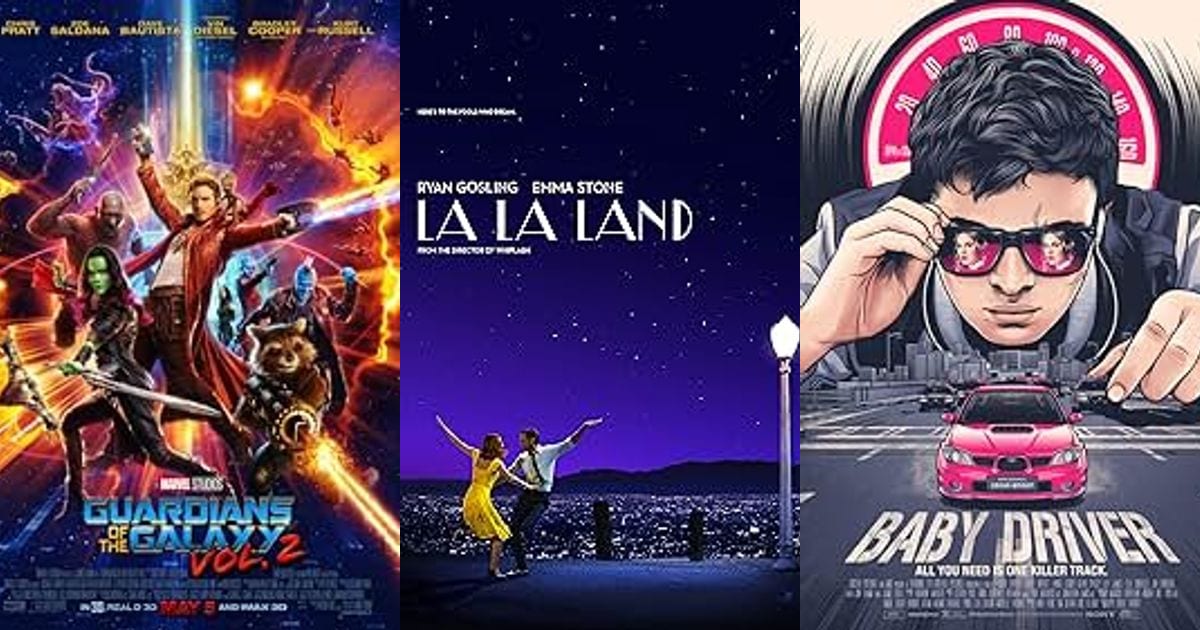
Pulp Fiction didn't invent the compilation soundtrack, Martin Scorsese had been building meticulously chosen pop and rock playlists into films like Goodfellas (1990) for years, but Tarantino turned needle-drop curation into a directorial signature, and the technique has only grown since. James Gunn's Guardians of the Galaxy (2014) built an entire marketing hook, the in-universe "Awesome Mix" mixtape, around classic rock and soul cuts, proving audiences will buy a soundtrack album for songs decades older than the movie itself. Wes Anderson's meticulously art-directed soundtracks, mixing British Invasion pop with obscure folk cuts, do something similar on a smaller, quirkier scale: the music choices become part of the film's visual and emotional design, not just background noise.
When Silence Is the Score
Every rule about music's power has an equally powerful exception, and the boldest is simply refusing to use any. The Coen brothers' No Country for Old Men (2007) contains almost no score at all, composer Carter Burwell contributed only a handful of minutes of music across the entire runtime, letting the wind, footsteps, and Anton Chigurh's unnervingly calm breathing carry the tension instead. It's a reminder that silence is also a compositional choice, and sometimes the scariest thing a filmmaker can do is take the safety net away entirely and trust the audience to sit in the discomfort of real, unscored quiet. Alfred Hitchcock understood a version of this too: much of Psycho plays without music at all, which is exactly why Herrmann's shrieking strings land so hard when they finally arrive, the silence is doing setup work for the noise.
The Modern Blockbuster Score
Contemporary composers have kept pushing the form in new directions. Hans Zimmer's booming brass "BRAAAM" hits for Inception (2010) became so widely imitated in movie trailers that the sound briefly turned into its own action-movie cliche, while his organ-and-strings score for Interstellar (2014) traded bombast for something more intimate and devastating, using a church organ to suggest both the vastness of space and a father's grief. Zimmer pushed even further into unconventional territory with Dune (2021), commissioning custom-built instruments and heavily processed vocals to create a score that sounds almost nothing like a traditional orchestra, yet still functions exactly like one: cueing dread, awe, and scale precisely when the story needs it. Whether it's a full symphony, a wall of synthesizers, or someone's carefully assembled vinyl collection, the job has never changed since Herrmann's first shriek or Williams's first fanfare: make the audience feel something they can't quite explain, and make sure they can't imagine the scene any other way afterward.
How to Host a Movie Quiz Night (With a Free 40-Question Quiz)
The format, the timing, the scoring, and the four mistakes that sink most home quizzes — plus a complete 40-question movie quiz with answers, ready to run tonight.
Guess the Film From a Terrible Plot Summary: 30 Questions With Answers
Thirty films described as unhelpfully as possible, with answers. The rare quiz where being wrong is funnier than being right — and no film knowledge is wasted.
Christmas Movie Quiz: 50 Questions and Answers for the Family
Fifty Christmas film questions with answers, built for a room containing both a nine-year-old and an uncle who insists Die Hard counts. Five rounds, no printing.