
Huge Spoilers Ahead
There's no feeling quite like a perfectly landed plot twist: your jaw drops, your brain scrambles to re-file everything you just watched, and you realize the movie was playing you the entire time. A truly great twist doesn't just shock — it demands an immediate rewatch. Consider this your final spoiler warning.
- The Empire Strikes Back (1980): "No, I am your father." It didn't just shock Luke Skywalker — it recontextualized the entire saga from good-versus-evil into a family tragedy.
- The Sixth Sense (1999): The reveal that Bruce Willis has been a ghost the whole time works because the clues were there all along — he never opens a door, his wife never once looks at him — and we simply refused to see it.
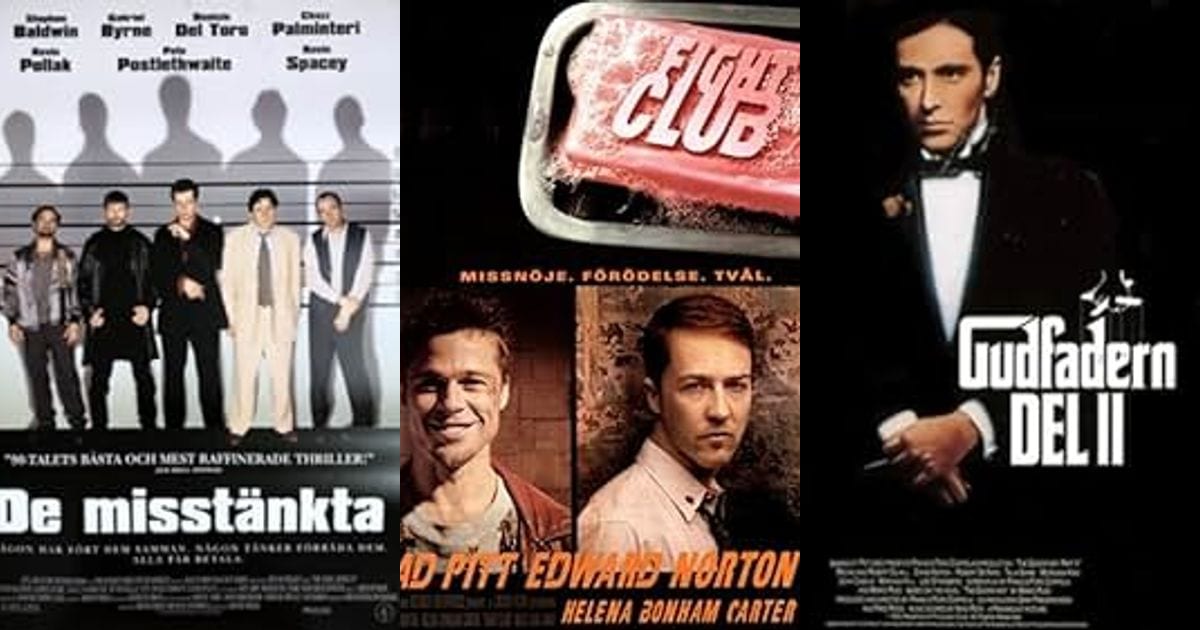
- The Usual Suspects (1995): "The greatest trick the Devil ever pulled was convincing the world he didn't exist." Verbal Kint's limp dropping away as he walks down the street remains one of cinema's coolest closing images.
- Oldboy (2003): The Korean masterpiece delivers arguably the most devastating twist in film history, turning a violent revenge thriller into a Greek tragedy in its final ten minutes. It hurts — but you can't look away.
- Se7en (1995): "What's in the box?" A gut-punch of a final act that subverts the entire buddy-cop formula the film spent two hours carefully building, trading resolution for pure dread.
- Psycho (1960): Alfred Hitchcock killed off his seeming protagonist a third of the way through, then quietly revealed that the sweet old woman running the motel had been dead for years — and that "Mother" was Norman Bates the entire time. It rewrote what audiences could expect from a leading lady, and from a thriller in general.
- Fight Club (1999): Tyler Durden was never a separate person. The narrator has been talking to, fighting, and following himself the whole film, and once you know that, half the dialogue plays like a completely different movie.
- Planet of the Apes (1968): A half-buried Statue of Liberty tells Charlton Heston — and the audience — that the "alien" planet he's been fighting to escape was Earth all along. Few final shots have ever landed a thesis statement so efficiently.
Why Twists Work (When They Work)
A great twist isn't a magic trick pulled from nowhere — it's closer to a magic trick performed in plain sight, where the misdirection only works because the fundamentals were fair. The best ones follow what's sometimes called the "fair play" rule: everything the audience needs to solve the puzzle is technically on screen, but arranged so that our attention lands somewhere else. The Sixth Sense is the textbook case, but it's worth noting how disciplined the misdirection actually is — every scene plays perfectly well on a first watch as an ordinary, if melancholy, drama, and only on a second viewing does it reveal itself as an elaborate structural puzzle. That's the difference between a twist that feels earned and one that feels like a cheat: the cheat requires new information invented after the fact, while the earned twist requires only a shift in how you're reading information you already had.
The Twist That Rewrites the Genre
Psycho deserves special attention because its twist didn't just surprise audiences — it fundamentally changed what a thriller was allowed to do. Killing off Janet Leigh's character, who the marketing and the first act had positioned as the film's lead, broke an unspoken contract between filmmaker and audience. Hitchcock understood that the shock of the shower scene was only half the trick; the real twist was psychological, revealed later, when Norman's dissociative identity is uncovered. It's a twist built entirely on withheld context rather than a single flashy reveal, and it set the template for decades of psychological thrillers that followed, from Identity to Shutter Island.
When the Twist Is Structural, Not Just a Reveal
Not every great twist is a single sentence or a single shot — sometimes the twist is baked into the film's entire architecture. Memento tells its story in reverse chronological fragments specifically so the audience experiences the same disorientation and unreliable memory as its amnesiac protagonist; the "twist" is less a moment than a slow, dawning realization about who Leonard actually is and what he's capable of convincing himself of. Arrival plays a similar game, restructuring our understanding of time itself once the film reveals that its framing scenes aren't flashbacks at all. These structural twists tend to reward rewatching even more than a single-line reveal, because literally every scene needs to be re-read in light of the new information, not just the ending.
The Prestige and the Price of a Twist
Christopher Nolan's The Prestige is practically a thesis on the mechanics of misdirection, fittingly, since it's a film about stage magicians. The reveal that Hugh Jackman's character has been using a real cloning machine, killing a copy of himself every night for a magic trick, only works because the film has spent its runtime training you to expect a mundane explanation — the kind any good magician relies on. It's a twist that's willing to be genuinely strange rather than merely clever, and it rewards viewers who remember the film's own opening line: "Are you watching closely?"
The Quiet Ones
Not every unforgettable twist arrives with a musical sting or a slow zoom. Bong Joon-ho's Parasite escalates almost casually — the discovery of a second family secretly living in the basement doesn't announce itself as "the twist," it just quietly detonates the class satire the film had been building and turns it into something far darker and stranger. That restraint is its own kind of mastery: by the time you register how thoroughly the rules of the story have changed, the film has already moved on to the consequences.
The Shyamalan Effect
No director's career is more tied to the reputation of the twist ending than M. Night Shyamalan's, and it's worth examining both sides of that legacy. The Sixth Sense made "the Shyamalan twist" a genre unto itself, and he followed it with Unbreakable and Signs, films that used reveals to reframe ordinary lives as something mythic. But the same trademark eventually became a trap: once audiences arrived at every Shyamalan film hunting for the twist, films like The Village found their surprises deflated by sheer anticipation, and the backlash to Lady in the Water and The Happening showed what happens when a signature device turns into an expectation the film can't outrun. It's a useful cautionary tale for the genre as a whole: a twist that works by catching you off guard stops working the moment audiences start actively guarding against it.
The Rewatch Test
The single best way to separate a great twist from a cheap one is to actually rewatch the film knowing the ending. A cheap twist collapses on a second viewing — the earlier scenes suddenly look nonsensical, or characters behave in ways that only make sense if they somehow knew a piece of information the plot insists they didn't have yet. A great twist does the opposite: it gets richer. Watch The Usual Suspects a second time and Kevin Spacey's Verbal Kint isn't just narrating a story anymore, he's performing an elaborate improvisation in real time, borrowing names off a bulletin board in the police station as he invents his confession. Watch Fight Club again and every scene where the narrator and Tyler Durden share a frame becomes a small directorial magic trick, since Fincher had to stage those interactions so Edward Norton was, technically, always alone.
When a Twist Becomes a Genre Cliché
Success breeds imitation, and imitation eventually breeds parody. The "it was all in his head" twist, the "he was dead the whole time" twist, and the "evil twin" twist all became so common in thrillers throughout the 1990s and 2000s that audiences started anticipating them by default, which is its own kind of problem for screenwriters. Some films have leaned into that fatigue rather than fighting it: Scream built an entire franchise out of characters who have seen enough horror movies to correctly predict — and occasionally still fall victim to — the genre's own twist conventions. That kind of self-aware winking only works because the well of "sincere" twists had already been dug so deep that audiences needed a film willing to acknowledge the trope out loud.
Twists That Reward a Second Movie, Not Just a Second Viewing
Some of the most satisfying twists don't even resolve within a single film — they retroactively reshape an entire earlier movie once a sequel arrives. Revealing Vader's parentage in The Empire Strikes Back did more than shock audiences in the moment; it sent an entire generation back to rewatch the original Star Wars with new eyes, hunting for hints that weren't originally intended to be hints at all, since Lucas has been candid that the reveal wasn't fully mapped out from the very beginning. That's the rarest and most valuable kind of twist: one that makes you want to watch not just the film you just saw again, but everything that came before it too.
Great twists aren't tricks. They're stories that were honest with you the entire time — you just weren't ready to listen.
The Weirdest Celebrity Cameos You Completely Forgot Were in These Movies
From Hitchcock sneaking into his own films to Tom Cruise vanishing under prosthetics, here are the real, documented celebrity cameos so blink-and-you-miss-it that even devoted fans forget they happened.
The Most Ridiculous Movie Taglines Hollywood Ever Approved
From sharks with grudges to sequels that admit they're not on a bus anymore, we rank the movie taglines so absurd they looped back around to genius — plus the rare ones that actually nailed it.
Movie Continuity Errors So Good They Became Legendary
From Pulp Fiction's shape-shifting wallet to Braveheart's time-traveling extras, some movie mistakes are so beloved that fans wouldn't dream of fixing them. Here's why continuity errors happen, and the famous ones we can't stop talking about.