
The Golden Age of Explosions
Forget today's CGI-heavy superhero fests. The 1990s were a different beast — practical stunts, heroes who actually sweated, and explosions that destroyed real buildings. High-concept pitches ("It's Die Hard on a bus!") turned into box office gold. Budgets were smaller by modern blockbuster standards, but the stakes were, paradoxically, higher: a stunt performer was actually on that motorcycle, actually falling off that building, actually driving that car into oncoming traffic. There's a specific, visceral quality that comes from watching real mass move at real speed, and the 1990s gave audiences more of it, more often, than any decade before or since.
The Undisputed Champions
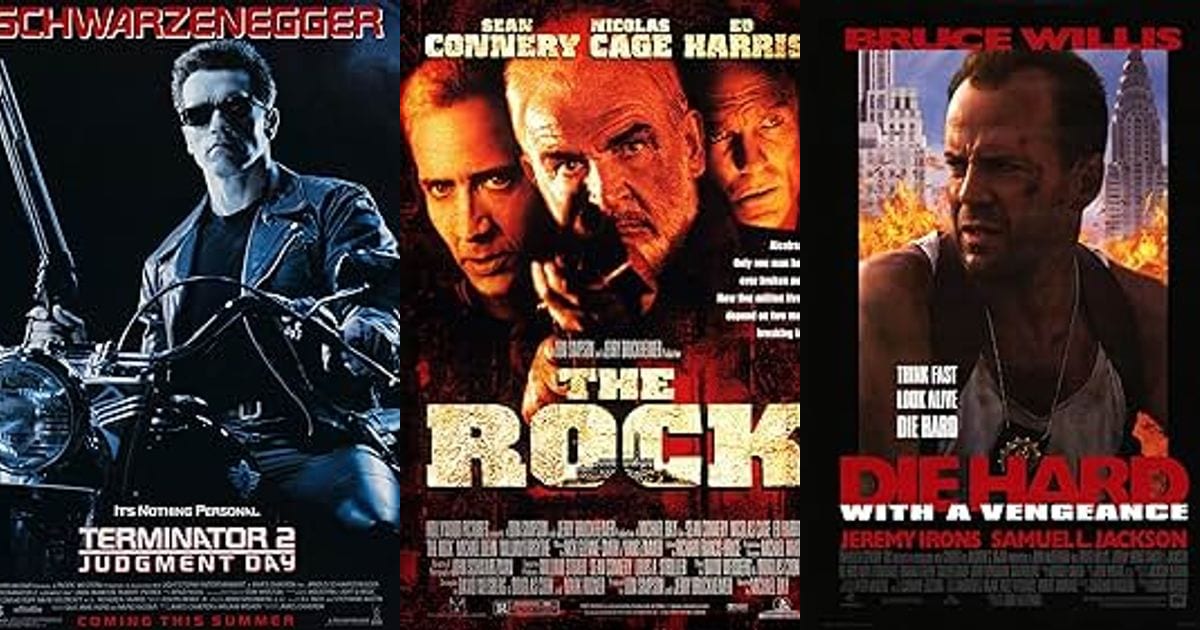
- Terminator 2: Judgment Day (1991): James Cameron didn't raise the bar, he launched it into orbit. The liquid-metal T-1000 still terrifies, but the real star is the LA drainage-canal chase — a real semi-truck jumping off a real bridge, no pixels involved. At a reported budget north of $100 million, it was, at the time, one of the most expensive films ever made, and Cameron spent that money on a strange marriage of cutting-edge digital morphing from ILM and old-fashioned Stan Winston animatronics, so the T-1000's liquid menace always felt like it had real weight and mass, not just math.
- Speed (1994): "Pop quiz, hotshot." The premise is laughably simple — a bus that can't slow down — but the execution is masterclass tension, and it proved Keanu Reeves was an action god, not just a surfer dude. It was also the directorial debut of Jan de Bont, previously a celebrated cinematographer on films like Die Hard and Basic Instinct, and it made a genuine movie star out of Sandra Bullock, who spent much of the runtime doing her own driving through closed-off Los Angeles freeways.
- The Matrix (1999): It closed out the decade by rewriting the rules of action cinema. Bullet time and wire-fu became the new standard overnight. Before this, fight scenes were clumsy brawls; after, they were ballet. The Wachowski siblings imported Hong Kong fight choreographer Yuen Woo-ping to train the entire cast for months before filming, and the now-iconic bullet-time photography required a custom rig of dozens of still cameras arranged in an arc, a technique so new that much of the crew building it didn't fully know if it would work until they saw the footage.
- Face/Off (1997): John Woo, Nicolas Cage, and John Travolta at maximum absurdity. Violent, balletic, and completely unhinged — priest-costume dancing during an explosion included. Woo brought his signature Hong Kong grammar to Hollywood wholesale: slow-motion gunfights, Mexican standoffs, and his trademark white doves fluttering through scenes of mass carnage, all built around the gloriously stupid premise of two enemies literally swapping faces via surgery, sold almost entirely through sheer directorial conviction.
Fun fact: In Speed, the famous bus jump over the unfinished highway bridge was real — but the driver was a stunt performer strapped into a suspension seat in the rear of the bus to survive the landing.
"Die Hard On A ___": The High-Concept Boom
Die Hard (1988) technically arrived just before the decade started, but the 1990s were where its DNA truly metastasized. Studio pitch meetings became a game of Mad Libs: take a lone hero, a confined location, and a ticking clock, then fill in the blank. Under Siege (1992) was Die Hard on a battleship, with Steven Seagal's chef-turned-Navy-SEAL taking out mercenaries belowdecks. Air Force One (1997) put Harrison Ford's president in the Die Hard role aboard a hijacked plane. Con Air (1997) flipped the formula slightly: instead of one good guy trapped with a handful of bad guys, it was one good guy trapped among a planeload of convicts on a prisoner transport flight gone wrong. The formula was shameless and endlessly recycled, and, somehow, it kept working, because the underlying structure — one resourceful person, nowhere to run, forced to improvise — is basically bulletproof storytelling. Broken Arrow (1996) tried it with stolen nuclear warheads in the desert, Sudden Death (1995) tried it inside a hockey arena during a Stanley Cup Final, and even Under Siege got its own belated riff two years later with Under Siege 2: Dark Territory, this time trapping Seagal on a train instead of a battleship. Studio executives didn't just tolerate the repetition, they actively hunted for it, because a two-sentence pitch that instantly conjured a poster and a trailer was worth more in a greenlight meeting than a stack of pages nobody in the room had time to read.
Bruckheimer, Bay, and the Cult of the Practical Explosion
No producer defined the back half of the decade's action aesthetic more than Jerry Bruckheimer, and no director executed that aesthetic more aggressively than Michael Bay. Bay's directorial debut, Bad Boys (1995), paired Will Smith and Martin Lawrence as mismatched Miami detectives and established the template: slow-motion hero shots, needle-drop soundtracks, and a camera that never stopped moving. The Rock (1996) upped the ante considerably, filming extensively around the real Alcatraz island and pairing Sean Connery's aging former British agent with Nicolas Cage's chemist against a hostage plot involving stolen VX gas rockets — a film that somehow made a decommissioned federal prison feel like the most dangerous place on Earth. Bruckheimer also produced Con Air the following year, directed by Simon West, cementing a house style so recognizable it became a genre unto itself: practical pyrotechnics stacked on practical pyrotechnics, filmed with an orange-and-teal color palette years before that look became an internet punchline.
When the Bullets Were Real: Heat's Downtown Shootout
Michael Mann's Heat (1995) sits slightly outside the pure popcorn category, but its centerpiece bank robbery and downtown Los Angeles shootout between Robert De Niro's crew and Al Pacino's detectives is frequently cited as one of the most technically accurate gunfights ever filmed. Mann had his cast undergo real firearms training so their reloads, stances, and recoil control would look like trained professionals rather than actors waving prop guns, and the sequence was filmed on actual downtown LA streets rather than a soundstage, with the gunfire mixed to sound less like typical Hollywood pyrotechnics and more like a genuine, ear-splitting firefight. The scene's influence shows up everywhere from Christopher Nolan's Batman films to countless heist movies that followed, all trying to replicate that specific sense that this is what a real shootout between trained people would actually sound and feel like.
Fun fact: For Heat's downtown shootout, Michael Mann had his actors drill extensively with real firearms so their handling would read as authentic rather than performed — a level of preparation rarely afforded to an action sequence before or since.
Bond Gets a 90s Reboot: GoldenEye
James Bond had spent the early 90s in franchise limbo, sidelined by legal disputes, until GoldenEye (1995) reintroduced Pierce Brosnan and reminded audiences why practical stunt work could still open a movie better than any line of dialogue. The pre-credits sequence sends Bond off the edge of the Contra Dam in Switzerland on what was, at the time, the highest bungee jump ever filmed, performed for real by a professional stunt jumper rather than faked with harnesses on a soundstage. The film's back half escalates into a tank chase through the streets of St. Petersburg, with a genuine armored vehicle flattening cars and fountains for real rather than through digital compositing. GoldenEye also introduced a generation of players to its own tie-in video game, but on screen, it was really just one more example of the decade's core philosophy: if it's dangerous enough to be memorable, put a professional in front of a real camera and let them actually do it.
The Stunt Performers Nobody Remembers
For every star's name above the title, there was a stunt performer whose name never made the poster but whose body absorbed the actual risk. Point Break (1991), Kathryn Bigelow's surfing-and-skydiving heist thriller, sent its cast and crew genuinely out of airplanes, with Patrick Swayze — an experienced outdoorsman in his own right — performing a number of his own stunts under close supervision from professional skydiving coordinators. True Lies (1994) reunited James Cameron with Arnold Schwarzenegger fresh off Terminator 2 and closed with a climax involving a Harrier jet, practically rigged and flown for the cameras rather than composited after the fact, punching a missile through a hotel window with Schwarzenegger dangling from the cockpit. These sequences required months of rehearsal, purpose-built rigs, and a tolerance for risk that no modern insurance policy would casually sign off on today. The directors and stars got the credit; the stunt coordinators and doubles who made the physics believable rarely got so much as a mention outside the closing credits crawl. It's worth remembering that this was also an era before digital de-aging, digital stunt doubles, or seamless face replacement existed as viable tools, so a director who wanted a hero to leap between two moving vehicles had exactly one honest option: find someone brave enough, insured enough, and skilled enough to actually do it, then point the camera at the right angle and hope the footage came out usable on the first or second take.
When Bruce Willis got punched, he bled. When a car crashed, metal actually crunched. Today's action is slicker and louder, but rarely this dangerous, and rarely does it leave you with the nagging, thrilling suspicion that somebody, somewhere on that set, could actually have gotten hurt making it.
The Weirdest Celebrity Cameos You Completely Forgot Were in These Movies
From Hitchcock sneaking into his own films to Tom Cruise vanishing under prosthetics, here are the real, documented celebrity cameos so blink-and-you-miss-it that even devoted fans forget they happened.
The Most Ridiculous Movie Taglines Hollywood Ever Approved
From sharks with grudges to sequels that admit they're not on a bus anymore, we rank the movie taglines so absurd they looped back around to genius — plus the rare ones that actually nailed it.
Movie Continuity Errors So Good They Became Legendary
From Pulp Fiction's shape-shifting wallet to Braveheart's time-traveling extras, some movie mistakes are so beloved that fans wouldn't dream of fixing them. Here's why continuity errors happen, and the famous ones we can't stop talking about.