
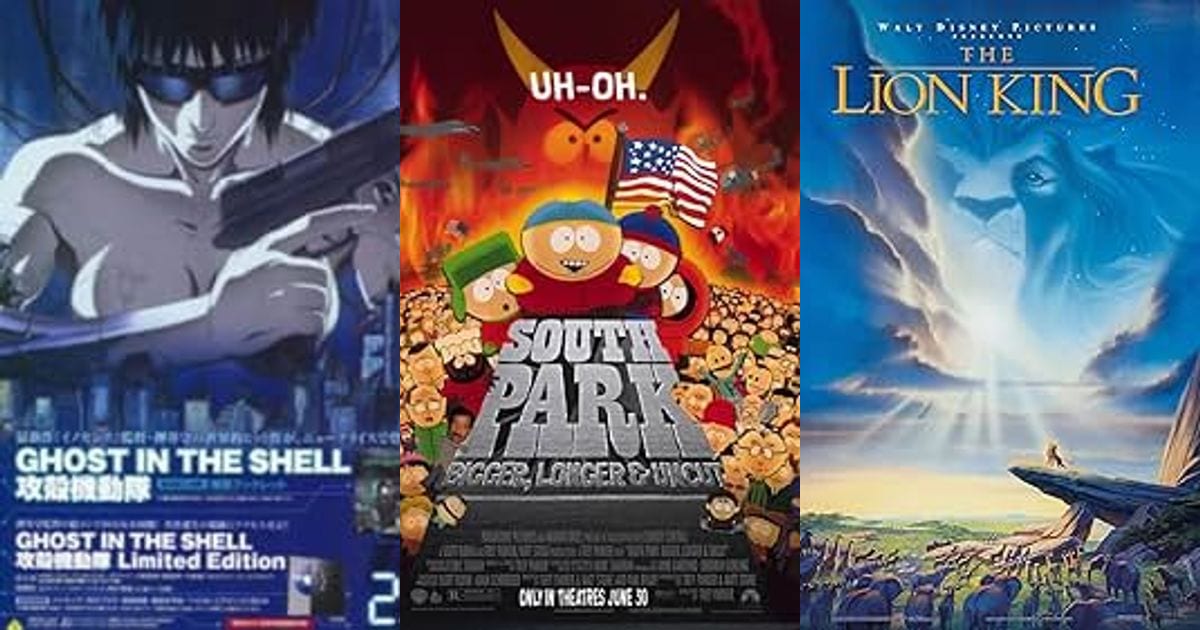
Beyond Saturday Morning Cartoons
There's a stubborn Western assumption that if it's drawn, it's for kids eating cereal on a Saturday morning. Animation is a medium, not a genre — a tool for telling any story, including ones packed with violence, trauma, and heartbreak. If you think cartoons are just for babysitting, these five will shatter that illusion.
A Brief History of Animation Growing Up
The idea that drawn imagery is inherently childish is a fairly recent, fairly Western invention, and it took real effort to enforce. Early animation was never exclusively for children — Fleischer Studios' Betty Boop cartoons of the 1930s were packed with surreal, adult-coded innuendo before the Hays Code cracked down, and wartime propaganda shorts (including some genuinely unsettling work commissioned from Disney itself) used animation to convey ideas far too grim for a Saturday matinee. The real turning point came with Ralph Bakshi's Fritz the Cat (1972), the first animated feature to receive an X rating in the United States — a raunchy, politically furious satire that proved, loudly and unapologetically, that a cartoon could be made exclusively for grown-ups. Around the same time, Japan was developing an entirely separate tradition where animation, or anime, was never boxed into a single age bracket to begin with; manga and anime aimed at teenagers and adults were simply part of the mainstream media diet, which is a big part of why so many of the films on this list come from Japanese studios. By the time the films below arrived, the tools existed — audiences and critics just needed convincing.
- Akira (1988): A cyberpunk landmark — hyper-violent, visually overwhelming, and steeped in government corruption and post-war Japanese trauma. It influenced everything from The Matrix to modern music videos.
- Grave of the Fireflies (1988): Studio Ghibli's harrowing story of two siblings surviving WWII-era Japan. One of the most devastating anti-war films ever made — animated or not. Watch once, cry uncontrollably, never watch again.
- Perfect Blue (1997): A psychological thriller about a pop idol whose grip on reality shatters under an obsessive stalker. It blurred dream and reality so effectively it directly influenced Darren Aronofsky's Black Swan.
- Waltz with Bashir (2008): An animated documentary exploring a soldier's suppressed memories of the 1982 Lebanon War, using surreal imagery to make real horror feel tangible.
- Anomalisa (2015): Charlie Kaufman's stop-motion story of a man mid-crisis in a world where everyone sounds identical — a melancholy meditation on loneliness that puppets somehow convey better than actors could.
Akira: The Film That Rewired a Generation of Filmmakers
Katsuhiro Otomo didn't just direct Akira, he adapted it from his own sprawling manga while the film was still being produced, compressing a multi-volume epic about psychic children, biker gangs, and a collapsing near-future Tokyo into a single feature with a scale and ambition that hadn't really been attempted in animation before. The film's opening shot alone — a nuclear blast leveling Tokyo, replaced by "Neo-Tokyo," rebuilt on the crater's edge — sets a tone of civilizational anxiety that never lets up. That anxiety wasn't abstract: Akira arrived from a country that had lived through actual nuclear devastation and a postwar reconstruction boom that left deep scars alongside its neon-lit skyscrapers, and the film channels both the trauma and the technological hubris directly into Tetsuo's body-horror transformation, a kid whose psychic powers grow faster than his body or mind can contain them. Western audiences discovering it on VHS and later DVD saw something they'd never seen animation do before, and the ripple effects are still visible: the Wachowskis have cited it as an influence on The Matrix's visual language, and its motorcycle slide, practical-effects-grade explosions, and grimy cyberpunk texture have been echoed in music videos and blockbusters for over three decades.
Grave of the Fireflies: Ghibli's Other Side
It's worth sitting with the fact that Grave of the Fireflies and the whimsical My Neighbor Totoro were released as a double feature in Japan in 1988 — two films from the same studio, released the same day, occupying almost opposite emotional universes. Director Isao Takahata based the film on Akiyuki Nosaka's semi-autobiographical novel about two siblings, Seita and Setsuko, trying to survive firebombing, starvation, and the collapse of civil society in the final months of World War II. There is no villain to defeat and no lesson delivered with a bow on top; the film simply, unflinchingly documents what happens to children when the adults around them are too consumed by their own survival to help. Its power comes precisely from the medium: animation lets Takahata render wartime Japan with a level of intimate, hand-drawn specificity — the exact color of a tin of fruit drops, the flicker of fireflies in a shelter at night — that live-action recreation would struggle to match without feeling staged. It remains one of the most frequently cited "proof" films whenever someone claims cartoons can't handle real tragedy.
Perfect Blue: Satoshi Kon's Nightmare of Identity
Satoshi Kon's directorial debut follows Mima Kirigoe, a pop idol who quits her group to become an actress, only to find her sense of self unraveling as a stalker, an anonymous website chronicling her private life in eerie detail, and a series of violent murders connected to her new career collapse her grip on what's real. Kon uses animation's total control over every frame to do something live-action genuinely cannot: he cuts between Mima's actual life and scenes from the "gritty" TV drama she's filming so seamlessly that the audience loses track of which reality it's watching right alongside her, a trick that requires an animator's total authorship over every reflection, shadow, and camera angle. The film's fingerprints are all over modern psychological thrillers about fractured identity and media obsession, and Darren Aronofsky has been open about drawing directly from it for Black Swan, right down to specific shot compositions involving mirrors and doubling. Kon would go on to make Paranoia Agent, Millennium Actress, and Paprika before his early death in 2010, but Perfect Blue remains the sharpest introduction to why he's considered one of the most important animation directors to work in the medium.
Waltz with Bashir: Memory as Animation
Director Ari Folman built Waltz with Bashir around real interviews with his fellow veterans of the 1982 Lebanon War, then animated those testimonies rather than filming them conventionally — a choice that turns out to be the film's entire argument. Folman has explained that animation let him depict fragmented, unreliable, dreamlike memories — the exact texture of trauma and repression — in ways that live documentary footage, tied to literal photographic reality, never could. The film builds toward Folman's own suppressed memory of the Sabra and Shatila massacre, and the moment the animation finally gives way to real archival footage in the closing seconds is one of the most devastating formal choices in any war film, animated or otherwise. It's a documentary that argues, implicitly, that sometimes drawing is the most honest way to depict something too painful to film directly.
Anomalisa: Puppets Doing What Actors Can't
Charlie Kaufman and Duke Johnson's stop-motion feature follows Michael Stone, a burned-out motivational speaker on a work trip, staying in a hotel where every single person he meets — men, women, his own wife and child on the phone — has the same face and the same voice, until he meets a hotel guest named Lisa who, to him, sounds and looks entirely unique. The gimmick isn't a gimmick; it's a literal visualization of depersonalization and depression, of a mind so exhausted by disconnection that the rest of humanity has flattened into indistinguishable noise. Stop-motion puppets, with their faintly visible seams and uncanny not-quite-human movement, do something a live actor's face can't: they make Michael's alienation visible on every other character's face simultaneously, without a single line of dialogue explaining it. The film also included a notably frank, unglamorous intimate scene rendered entirely in puppet form, which unsettled some viewers precisely because it worked — proof that audiences still instinctively expect animation to soften things that live-action wouldn't.
Honorable Mentions for When You Need More Punishment
If these five didn't fully break you, animation's mature catalog runs deep. Watership Down (1978) is nominally a film about rabbits and was marketed to families in some territories, and it still manages to be one of the most quietly traumatizing things ever put in front of British children, thanks to its unflinching depictions of violence, death, and totalitarian rabbit warrens. Fantastic Planet (1973), a French-Czech stop-motion oddity, imagines humans as pets kept by giant blue aliens, and its psychedelic dread has influenced generations of surrealist animators. Persepolis (2007), adapted from Marjane Satrapi's own graphic memoir, uses stark black-and-white animation to tell a deeply personal story of growing up during and after the Iranian Revolution. When the Wind Blows (1986) follows an elderly British couple attempting to follow official civil-defense advice to survive a nuclear war, and it is exactly as bleak as that premise suggests. And Ghost in the Shell (1995), another cyberpunk touchstone alongside Akira, wrestles with questions of consciousness and identity in a cybernetic future so influential that the Wachowskis have credited it, alongside Akira, as a direct inspiration for The Matrix.
Why Animation Handles Heavy Subjects So Well
There's a real, mechanical reason animation keeps getting reached for when a story gets this dark, beyond simple novelty. Every frame in an animated film is a deliberate choice — nothing is accidentally in frame, no actor's performance can undercut a directorial intention, and no practical limitation of a real location or a real human body constrains what the story can show. That total control lets animators stage violence, memory, and psychological collapse with a precision and metaphorical freedom live-action can't always match: Tetsuo's body can grow and mutate in ways no practical effect could sell convincingly; Mima's identity can visually fracture across mirrors and television screens; Michael Stone's alienation can be written directly onto the faces of everyone around him. Animation also creates a strange, useful distance — audiences lower their guard slightly because a drawing "isn't real" in the same visceral way footage of a real actor is, which paradoxically makes it easier for a filmmaker to sneak past that guard and land an emotional gut-punch you didn't see coming. That's the trick every film on this list pulls off in its own way, and it's why dismissing animation as kids' stuff means missing some of the most emotionally punishing filmmaking of the last fifty years.
None of these needed a PG rating to be great — they needed a story worth telling, and animation turned out to be exactly the right tool for the job.
The Weirdest Celebrity Cameos You Completely Forgot Were in These Movies
From Hitchcock sneaking into his own films to Tom Cruise vanishing under prosthetics, here are the real, documented celebrity cameos so blink-and-you-miss-it that even devoted fans forget they happened.
The Most Ridiculous Movie Taglines Hollywood Ever Approved
From sharks with grudges to sequels that admit they're not on a bus anymore, we rank the movie taglines so absurd they looped back around to genius — plus the rare ones that actually nailed it.
Movie Continuity Errors So Good They Became Legendary
From Pulp Fiction's shape-shifting wallet to Braveheart's time-traveling extras, some movie mistakes are so beloved that fans wouldn't dream of fixing them. Here's why continuity errors happen, and the famous ones we can't stop talking about.